Pay for your fees and charges Pay Now
+233 (0) 243 211 345 info@ama.gov.gh GA-143-6657
Pay for your fees and charges Pay Now
+233 (0) 243 211 345 info@ama.gov.gh GA-143-6657

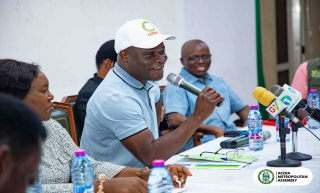
The Accra Metropolitan Assembly (AMA) has held its final public hearing to showcase the draft Medium Term Development Plan (MTDP) for 2026–2029 to key institutions, agencies, and stakeholders operating within the metropolis.
The two-day event, held on Tuesday and Wednesday, July 22 and 23, at James Town and Kaneshie, brought together participants, including Heads of Departments, Civil Society Organisations (CSOs), private sector actors, traditional leaders, community representatives, security personnel, and residents.
Key development issues identified through community engagements and integrated into the plan include poor road infrastructure, choked and inadequate drainage systems, poor sanitation, open defecation, youth unemployment, lack of recreational facilities, prostitution and drug abuse hotspots, coastal erosion, flooding, non-functional traffic lights, and the absence of public toilets in densely populated areas.
Addressing participants, the Director of Development Planning at AMA, Mr. Richard Kwame Oduro, said the hearing was critical in validating the draft MTDP, to guide Accra’s social, economic, and infrastructural development from 2026 to 2029 adding that the plan was prepared in line with the National Development Planning (System) Act, 1994 (Act 480), its Regulations (LI 2232), and the Local Governance Act, 2016 (Act 936).
“This public hearing is the final step in the participatory process. We are showcasing the draft plan and soliciting feedback from institutional stakeholders to ensure that the development priorities of the city are inclusive, practical, and implementable,” Mr. Oduro explained.
He noted that the plan builds on lessons from the current 2022–2025 MTDP and is aligned with the national “Resetting Ghana” agenda, focusing on job creation, resilient infrastructure, sustainable urban living, and prosperity for all.
‘’The plan’s vision is to transform Accra into a smart, safe and climate-resilient city with decent jobs and prosperity for all citizens,’’ he said stressing that the total estimated cost of implementation for the 2026–2029 MTDP was GH¢940,579,492.16, significantly lower than the previous plan’s budget of over GH¢2.1 billion, due to prioritisation and expected funding constraints.
Mr. Oduro also mentioned that each sub-metro, Ablekuma South, Okaikoi South, and Ashiedu Keteke, had contributed to the plan through community consultations, and that priorities were ranked to inform composite development programmes and annual action plans.
The Deputy Director of Waste Management at AMA, Mr. Victor Kotey, who also addressed the gathering, highlighted the worsening sanitation challenges and stressed the need for institutional collaboration and technological innovations in solid waste management.
He noted that the Assembly would rely on partnerships under Corporate Social Responsibility (CSR) initiatives to implement parts of the plan, adding that unauthorised street parking, refuse dumping, and inadequate waste logistics would also be tackled in the new cycle.
The draft MTDP identifies low revenue mobilisation, leakages, untimely release of statutory funds, weak private sector collaboration, and limited donor support as key anticipated challenges. Recommendations include expanding the tax base, digitising revenue collection, revaluing property rates, and engaging Public-Private Partnerships (PPPs).
Among the major proposed interventions are the relocation of fish smoking activities to the fishing harbour, pavement of public school compounds, rehabilitation of stalled projects such as the Salaga and Sempe markets, provision of recreational parks, improvement of drainage and road networks, and establishment of health facilities in underserved communities like New Mamprobi.
 04.May.2026

The Accra Metropolitan Assembly (AMA) is one of the Two Hundred and Sixty-One (261) Metropolitan, Municipal and District Assemblies (MMDAs) in Ghana and among the Twenty-Nine (29) MMDAs in the...Read More...
H72, Independence Avenue, Kinbu Garden
Digital Address: GA-143-6657
P. O. Box GP 385, Accra Central, Accra, Ghana
©Copyrights 2026 Accra Metropolitan Assembly. All rights reservedDeveloped by Akorsetec